
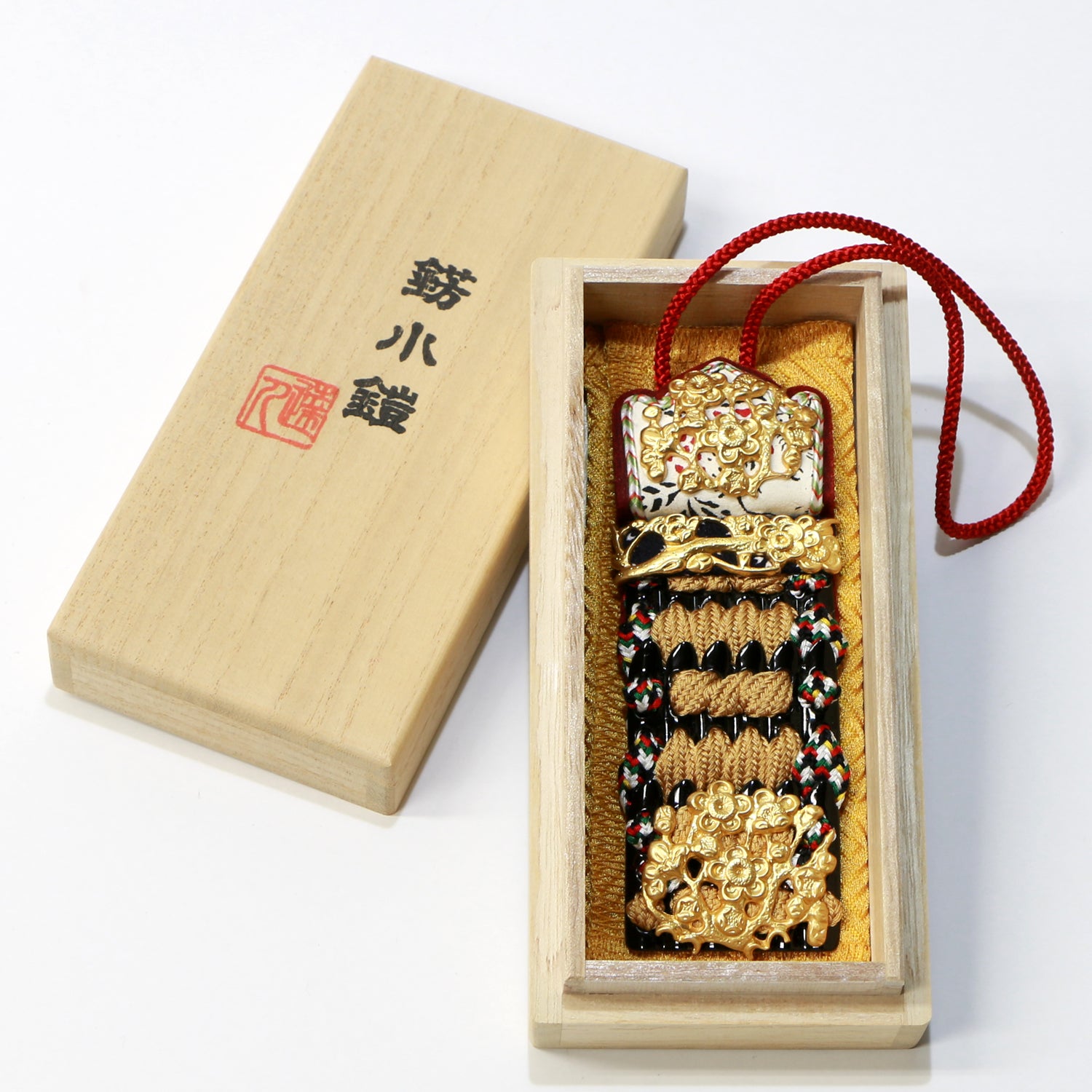
Accessoire d'armure nikitama / ume-uguisu
DESCRIPTION
DÉTAILS
SIZE
MATERIAL
ARTISAN
KOGEI
Attention
Choisir les options

Accessoire d'armure nikitama / ume-uguisu
Prix de vente$423.588,00
Pays
Langue
Panier
Votre panier est vide

Amulette facile à transporter, fabriquée par un artisan traditionnel à Kyoto.
Un objet empreint de l’esprit ancestral japonais, qui évoque l’esprit Yamato damashii et le code du Bushido.
Un bijou créé par un artisan qui a mis toute son âme dans le motif « Sendan no ita », destiné à protéger les points vitaux de la poitrine dans l’armure.
SIZE
Largeur : 4 cm
Hauteur : 11 cm
Poids : 100 g
MATERIAL
Cuivre
Soie tressée
KYOTO ARMOR
Connecting the thoughts of all who cherish parents and their children.
The philosophy behind this enduring armor-making tradition is to focus on materials and handcrafting. I always aim to produce high-quality crafts through meticulous handcrafting down to the finest details. The role of festival decorations is to celebrate milestones by displaying them annually, creating many memories and strong bonds each time. For this, the craft must be of such excellence that it withstands repeated viewings.
Furthermore, crafts made from carefully selected quality materials develop a deeper character over time. The Heianju Ichisui armor, growing alongside your son, will age over the years and eventually become a unique decoration like no other.
ARTISAN STORY
Kyoto Armor
In Taisho year 14 (1925), in Eikando-cho at the foot of the Higashiyama mountain range in Kyoto, the traditional Kyoto armor-making craft of Kazari Katchu was initiated by the armor fabric master, Zenjiro Imamura, under the name Heianju Ichisui. Since then, the techniques have been passed down through generations and further refined, continuing to this day.
KYO NINGYO / KYOTO SAMURAI ARMOR DOLLS
About 400 years ago / 1600s / Edo Period (1603–1868)
The custom of displaying armor for the Boys’ Festival grew from warrior culture, and by the Edo period craftsmen were producing miniature helmets and suits of armor for seasonal display. Kyoto makers drew on real armor-making skills—metalwork, leather, braided cord, lacquer and textiles—to create highly detailed festival pieces.
In Japan, these miniature armors are less symbols of warfare than protective objects. Families display them with wishes that children grow strong and remain safe from misfortune. Modern versions may be compact for contemporary homes, yet still preserve traditional lacing and helmet forms.
Even a tiny helmet can follow the construction of real armor with remarkable fidelity. Small scales are laced together, metal fittings are attached and leather details are applied. Miniaturization does not remove the complexity; it forces craftsmen to reproduce full-scale techniques at a dramatically reduced size.
Différences individuelles
Chaque pièce étant fabriquée à la main individuellement, de légères variations de couleur, de motif, de forme et de texture peuvent survenir. Ces subtiles différences sont une caractéristique naturelle des créations artisanales, ce qui rend chaque pièce véritablement unique. Nous espérons que vous apprécierez ces variations individuelles comme faisant partie de la beauté et du caractère de l'artisanat japonais.
Délai de production
Si un article n'est pas actuellement en stock, il peut être fabriqué sur commande par l'artisan. Comme chaque pièce est soigneusement fabriquée à la main, la production peut prendre plusieurs mois selon l'article et le planning de l'artisan. Nous vous remercions de votre patience et de votre compréhension.

Choisir les options
