
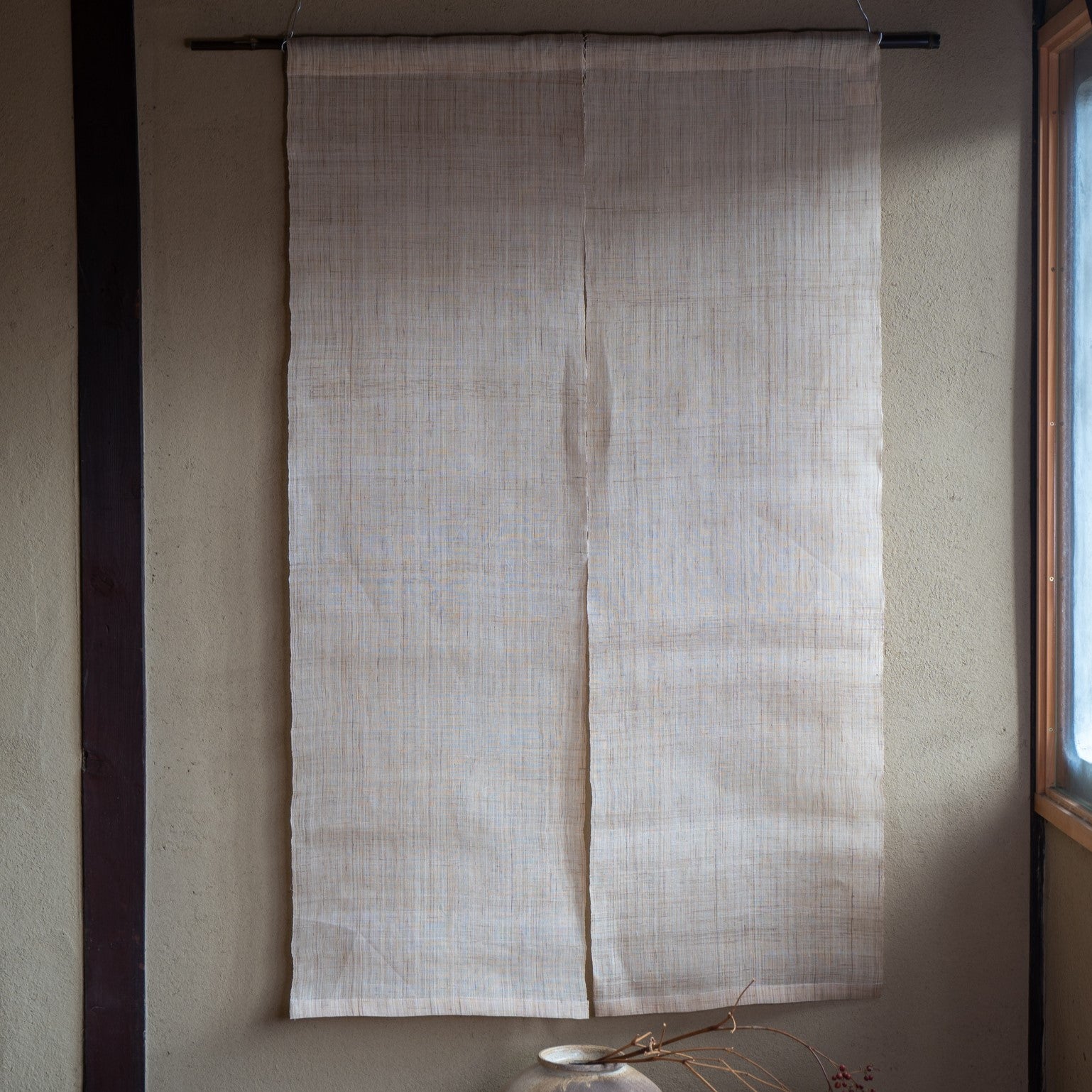
Rideau Noren / Teint à Kyoto / Couleur unie / Écru naturel
DESCRIPTION
DÉTAILS
SIZE
MATERIAL
ARTISAN
KOGEI
Attention
Choisir les options

Rideau Noren / Teint à Kyoto / Couleur unie / Écru naturel
Prix de vente9,967.00 ฿
Pays
Langue
Panier
Votre panier est vide

Ce noren uni, confectionné en lin et coton de haute qualité, met en valeur la beauté naturelle et la texture du tissu grâce à son design simple et raffiné.
Le lin et le coton sont utilisés depuis longtemps pour les noren traditionnels, offrant la respirabilité et la chaleur tactile propres à ces matières naturelles ancrées dans la culture japonaise.
Son design sobre et uni s'intègre parfaitement non seulement aux pièces de style japonais, mais aussi aux intérieurs modernes et aux espaces de bureau.
Il est également très apprécié comme séparation dans des cadres traditionnels tels que les ryotei (restaurants de style japonais) et les salons de thé, où son élégance discrète rehausse l'atmosphère d'une sophistication subtile.
SIZE
Largeur:88cm
Hauteur:150cm
Poids:450g
MATERIAL
100 % coton
SHOBIEN KYOTO
I want to convey the beauty of roketsu-zome.
In roketsu-zome, melted wax is applied to fabric before it is dyed.
This wax acts as a resist—known as bōsen—to prevent colors from blending.
While Yuzen-zome uses colored paste for this purpose, roketsu-zome allows the wax to naturally crack during the process,
creating beautifully irregular and expressive patterns in the final dyed fabric.
We invite you to enjoy the charm of these organic, one-of-a-kind patterns that only roketsu-zome can offer.
ARTISAN STORY
SHOBIEN KYOTO
Since our founding in 1963, our workshop has been captivated by wax dyeing and has devoted itself exclusively to wax.
The greatest appeal lies in the gentleness and softness that wax cracking brings out. We strive to ensure that our customers truly appreciate the beauty of hand-painted work, and we will continue to work diligently without forgetting our pride and efforts as craftsmen.
KYO YUZEN / KYOTO SILK DYEING
About 340 years ago / 1680s / Edo Period (1603–1868)
Kyo Yuzen took a decisive form in Kyoto’s Genroku era, when designs by the celebrated fan painter Miyazaki Yuzensai were applied to kimono. Fine paste-resist lines allowed many colors to be painted next to one another like a picture, establishing hand-painted Yuzen. In the Meiji period, stencil-based Yuzen greatly expanded production.
In Japan, Kyo Yuzen represents formal celebratory kimono worn for coming-of-age ceremonies, weddings and other important occasions. Brilliant dyeing may be combined with gold and embroidery, while the same techniques now appear on bags, scarves and interiors.
A single kimono can pass through more than twenty stages—design, underdrawing, resist application, coloring, steaming, washing, gold decoration and more. Different specialists often handle each stage, making Kyo Yuzen less the product of one maker than a collaborative artwork created by Kyoto’s craft network.
Différences individuelles
Chaque pièce étant fabriquée à la main individuellement, de légères variations de couleur, de motif, de forme et de texture peuvent survenir. Ces subtiles différences sont une caractéristique naturelle des créations artisanales, rendant chaque pièce véritablement unique. Nous espérons que vous apprécierez ces variations individuelles comme faisant partie de la beauté et du caractère de l'artisanat japonais.
Délai de production
Si un article n'est pas actuellement en stock, il peut être fabriqué sur commande par l'artisan. Comme chaque pièce est soigneusement fabriquée à la main, la production peut prendre plusieurs mois selon l'article et le planning de l'artisan. Nous vous remercions de votre patience et de votre compréhension.

Choisir les options
