

Lacquered Art Piece / "Did You Notice? No.5" / Hiroshima Lacquer
Product Description
Product Story
General Product Information
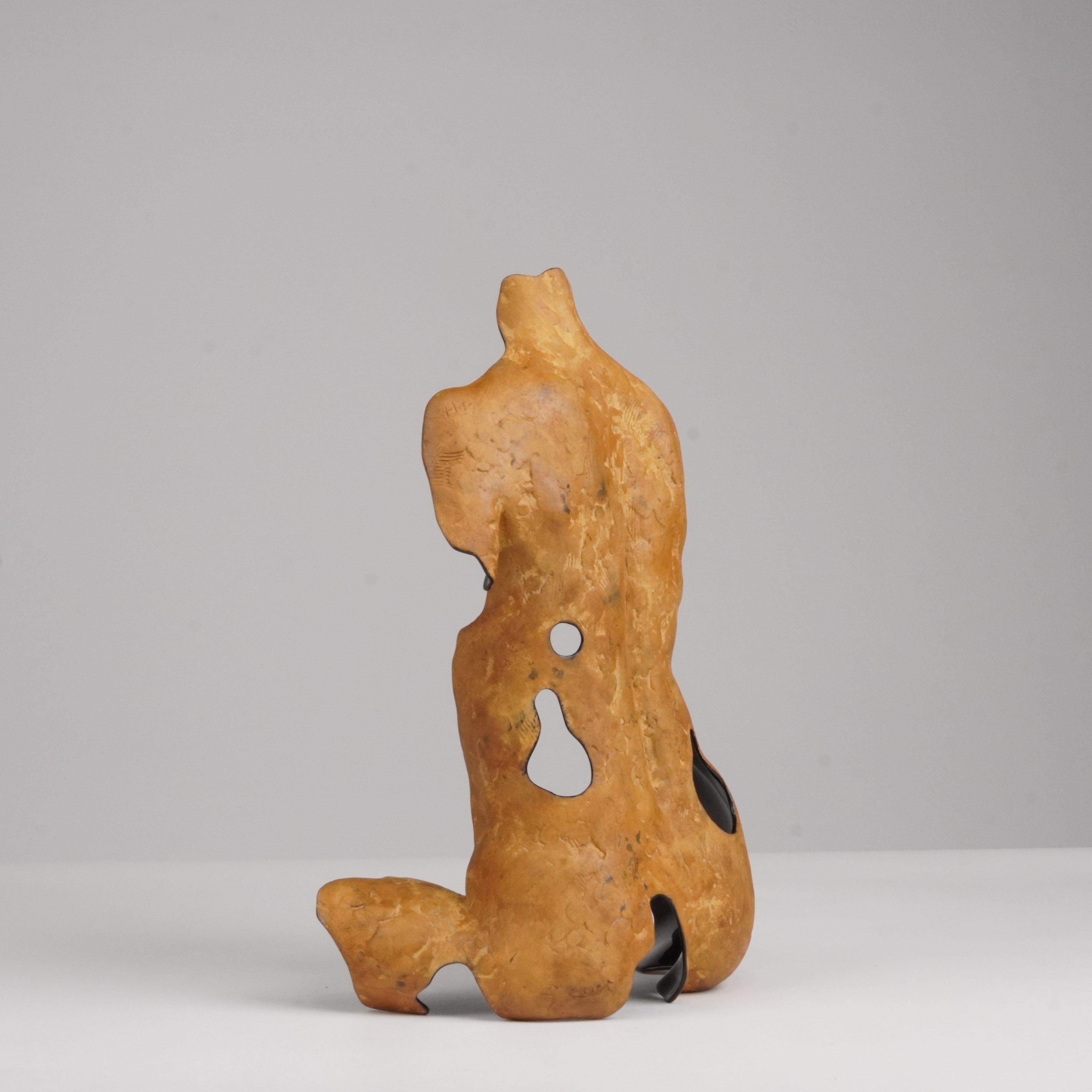
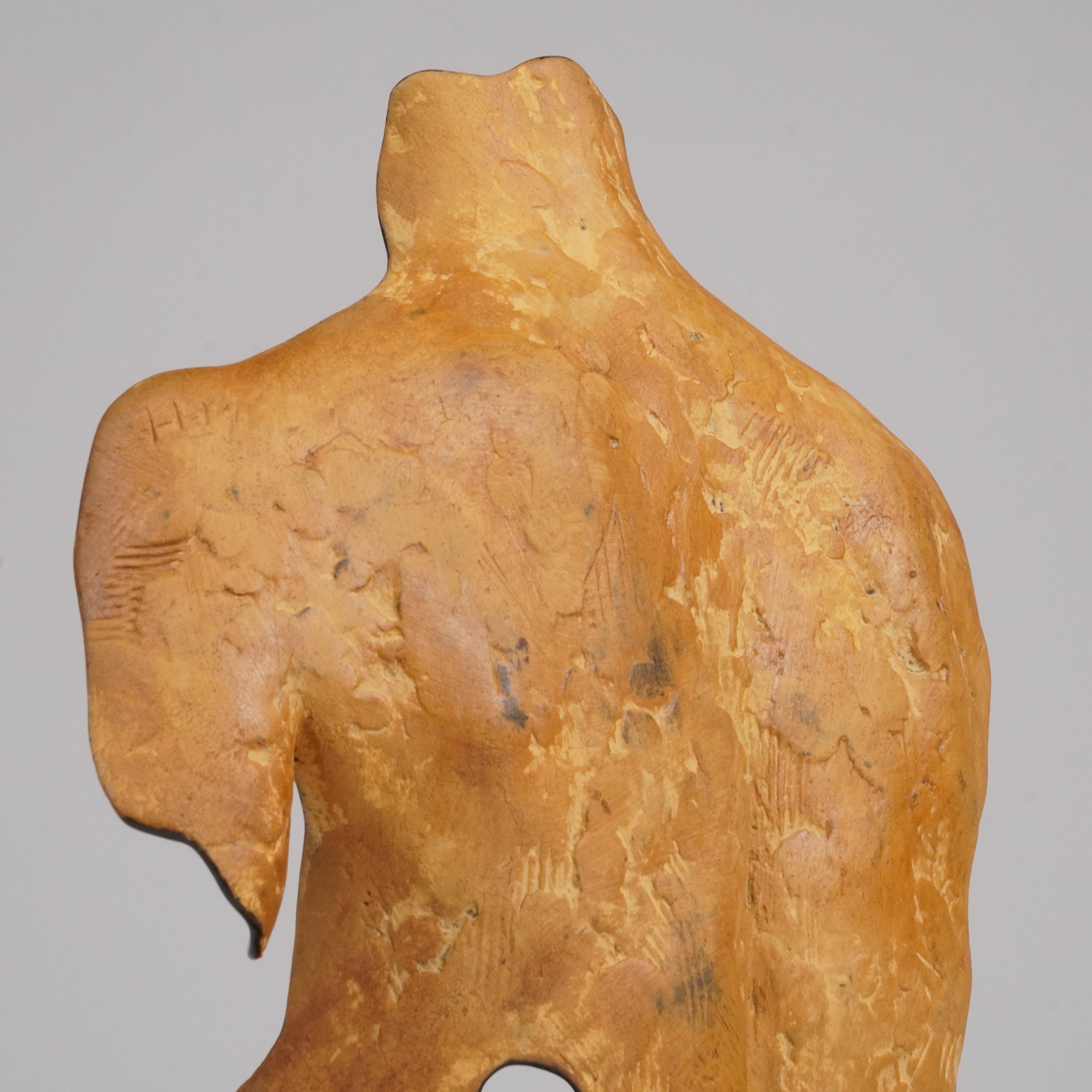
This work is created using the dry lacquer (kanshitsu) technique, with a focus on the human body—particularly the back.
Through interactions with others, we experience change, encounter differences, and accumulate many things, while at times losing others. These ambiguous and intangible aspects of life are expressed through the “back,” a part of the body invisible to oneself. The back, which can be seen by others but not by ourselves, inevitably reflects hidden aspects of our being that often go unnoticed.
The process begins with the artist modeling the original form in water-based clay, which is then cast in plaster. Inside the plaster mold, layers of dry lacquer are applied. Once the lacquer reaches sufficient thickness, the mold is broken apart, and the lacquer form is removed. The edges are then shaped, and the inner surface is finished using the nashiji technique, a traditional decorative method with tin powder. While the outer surface retains subtle uneven traces of the hand and spatula, the inside shines with a brilliant, lustrous finish created by nashiji, presenting a striking contrast between the inner and outer surfaces.
Product History
When did these crafts start to craft?:400 years ago / 1600AD / Edo period in Japan
Hiroshima has a long history of Buddhist propagation, beginning when disciples of Saint Shinran established temples such as Kōshōji and Shōrinbō. Under the protection of the Mōri clan, the number of followers grew, and the production of Buddhist altars flourished.
In 1619, Asano Nagaakira was transferred by order of the shogunate from Kii Province to Hiroshima. Skilled craftsmen accompanied him, bringing advanced techniques such as lacquerwork, which greatly enhanced the local production of Buddhist altars. Later, in 1716, a monk named Tontaka returned from Kyoto and Osaka with further refined skills in altar and ritual implement making, accelerating the craft’s development.
By the late Edo period, Hiroshima’s castle town had gathered specialized artisans—lacquerers who painted sword scabbards, and metal fittings craftsmen—whose skills were applied to Buddhist altar production.
During the Meiji era, the Seto Inland Sea’s shipping routes allowed large quantities of Hiroshima-made altars to be delivered to Kyoto and Osaka. Their exceptional quality was widely recognized, demand surged, and by the end of the Taishō era, Hiroshima had become the leading production center in Japan.
Although war and the atomic bombing drastically reduced both demand and the number of craftsmen, surviving artisans gradually revived the tradition. Thanks to their efforts, Hiroshima’s altar-making techniques have been faithfully preserved and passed on to the next generation, continuing into the present day.
Craftsman Story
Craftsman Profile
Kaori Fujita
I work on the theme of the human body, mainly the back.
For my three-dimensional works, I mainly use dry lacquer technique and combine it with other materials. Two-dimensional works are also painted with colored lacquer and, depending on the work, shells and metal powder are sometimes used.
While training in lacquer under Noaya Takayama, he is also pursuing his own artistic practice.

Craftsman Passion
Your back. Someone’s back. Or is someone's back a mirror that reflects oneself?
Using the back, whose own one cannot see, I try to visualize the changes that occur in people's relationships to each other, their differences, and the ambiguity and inability to grasp such things.
Your Contribution to Craftsman
Customer Voice
Due to the market structure (link for full articles are attached bottom), craftsman have not known who the customer is and how customer reacts to their work. We made a “Message to Craftsman” box at purchase page. We will deliver all message to every craftsman. Our review will be also shared to craftsman so please leave your comment and evaluation on review section!
Income for Craftsman: Craftsman get only less than 10% of selling price?
As written above, craftsman have not controlled last phase of sales channel that resulting in selling price is set by third-party without craftsman’s recognition. There are some cases that only less than 10% of selling price is given to craftsman. We promise with our customer / craftsman that we offer the fair trade with craftsmen in our contract!
We made an article about above problem and our challenge. Please have a read from below link.
Current state of the Crafts Market / Benefits brought by Suigenkyo
Measurement
Width:24cm
Depth : 13cm
Height:34.5cm
Weight:240g
Material & Caution
Materials
Dry lacquer
Lacquer
Caution
Individual Difference
Each piece is handmade, so there are individual differences even in the same series. We hope that you will understand the change by handmade.
Delivery Date
This item is one-of-a-kind.
If in stock, we can ship within about one week. If not in stock, we will cancel your order.
옵션 선택