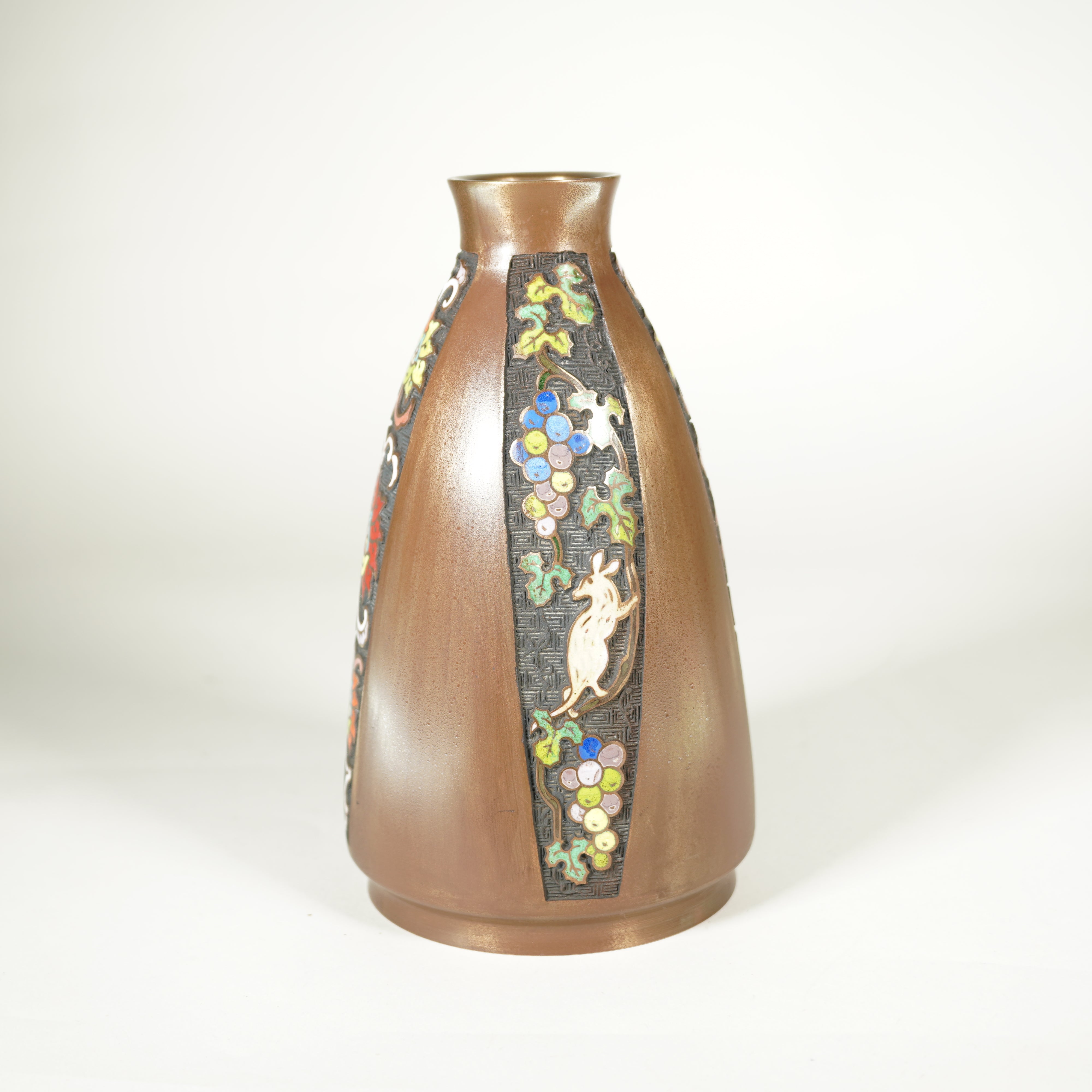
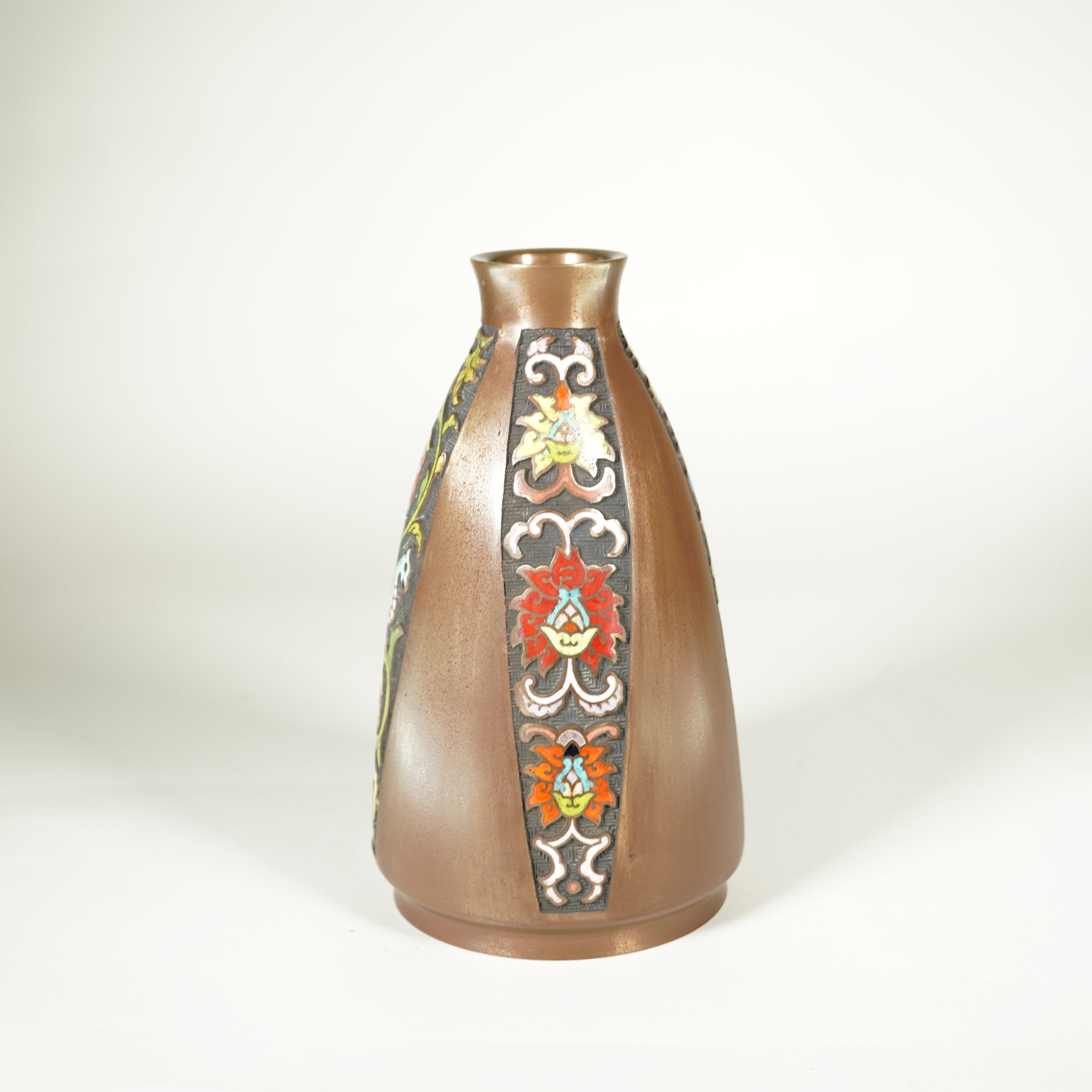
Flower Vase / Doro-shippo (Traditional Matte Cloisonné)
DESCRIPTION
DETAILS
SIZE
MATERIAL
ARTISAN
KOGEI
Caution
Choose options


Flower Vase / Doro-shippo (Traditional Matte Cloisonné)
Sale price€1.305,95
Country
Language
Cart
Your cart is empty


This vase is from Wadokan, the only workshop in Kyoto that produces inlaid cloisonne enamel ware.
The retro-inspired vase matches any room.
In Kyoto, cast bronze ware with cloisonne glaze has long been called mud cloisonne (in recent years, it has also been called inlaying cloisonne). Mud cloisonne enamel ware has many advantages: it can be made in large sizes, it can be colored with cloisonne enamel only where necessary, there is no need to glaze the inner surface, and the base material is durable. Cloisonne ware was produced in large quantities mainly for export from the Meiji period (1868-1912), and continued to be made until around 1985.
The entire manufacturing process was done by hand, requiring a great deal of skill, and cloisonne enamel ware was never produced outside of Kyoto, where the division of labor was well organized.
After the war, cloisonne enamel ware production in Kyoto resumed, but there were no more workshops specializing in cloisonne enamel ware coloring. Wadokan handles the entire process of cloisonne glaze production and coloring, from design to completion.
SIZE
Width : 13.5cm
Height : 24cm
Depth : 13.5cm
Weight : 2,200g
MATERIAL
Copper alloy
WADOKAN
Inheriting Traditional Techniques
Most modern cloisonne enamel works are wired, and Wadokan is the only company that continues to produce inlaying cloisonne enamel works today.
Wadokan's Zogan cloisonne enamel ware uses an opaque glaze, which produces an opaque, matte color after firing.
The classic design of this product gives a sense of time-honored tradition.
ARTISAN STORY
Wadokan
Wadokan was founded in 1909 as a manufacturer of cloisonne enamel ware. Cloisonne enamel ware techniques can be roughly divided into two types: inlaying cloisonne and wired cloisonne. In inlaying cloisonné, the boundary lines that demarcate the glaze are made by casting, while in wired cloisonné, silver wire is welded to the glaze. Most modern cloisonne enamel works are made by the wired method, and it seems that only Wadokan continues to produce zogan cloisonne enamel works today.
DORO SHIPPO / JAPANESE CLOISONNE
About 170 years ago / 1850s / Late Edo–Meiji Period
Doro shippo is a form of cloisonne using relatively opaque, earthy enamel fired onto a metal base. It developed as Japanese enameling expanded from the late Edo into the Meiji period. Unlike highly transparent wired cloisonne, doro enamel emphasizes dense color fields and a softer, more ceramic-like appearance.
In Japan, the technique has appeared on vases, dishes and ornaments and is valued for the warmth of its matte or opaque color despite being fundamentally glass fused to metal. Contemporary jewelry and small art objects have renewed interest in this surface quality.
Cloisonne is rarely finished in a single firing. Enamels shrink and melt differently by color, so layers may be filled, fired, polished and fired again. The maker must control the thermal behavior of both glass and metal so they expand and contract together—craftsmanship that quietly depends on materials science.
Individual Differences
As each piece is individually handcrafted, slight variations in color, pattern, shape, and texture may occur. These subtle differences are a natural characteristic of handcrafted works, making each piece truly unique. We hope you will enjoy these individual variations as part of the beauty and character of Japanese craftsmanship.
Production Time
If an item is not currently in stock, it may be made to order by the artisan. As each piece is carefully handcrafted, production may take several months depending on the item and the artisan's schedule. We appreciate your patience and understanding.

Choose options